
Last updated: June 2026. Hexarelin is still a research-stage peptide, not an FDA-approved medicine, and the human data on it are thin. Every clinical claim below is tied to a primary source you can look up yourself. I’d rather you check my homework than trust my byline.
I went into this expecting a straightforward price comparison. A research-chemical vial of hexarelin runs about $40 to $80. Supervised, prescription hexarelin through a clinic runs about $90 to $200. On paper, the gray-market option looks two to four times cheaper, and I’ll admit that’s where my brain went first too. Cheaper vial, same molecule, why pay more?
Here’s my honest read after sitting with it longer: that math only counts the molecule, and the molecule is the least interesting part of what you’re paying for. What you’re actually buying, or skipping, is the stuff wrapped around it. A licensed prescriber. A pharmacy. Identity and sterility testing. Someone who answers for it if the vial is wrong. Judge the two options on those line items instead of the sticker price and the whole comparison flips on its head. That’s the entire argument of this piece, and I built a scorecard to make me prove it rather than just assert it.
What it claims
Both sides of this market claim to sell you the same thing: a hexarelin vial. The research-chemical sellers imply that’s all there is to it, same peptide, lower price, why complicate it. The supervised clinics claim the extra money buys real medical oversight. I don’t take either claim at face value. I ran eight criteria, scored each path 0 to 2 on every one, and let the totals argue for themselves. Sixteen points possible, two paths, no vendor-versus-vendor cage match (I’ll explain why that comparison can’t be scored honestly, later).
One caveat up front, because burying it would be dishonest: hexarelin is harder to find through standard compounding channels than a flagship peptide like BPC-157, which is exactly why so much of its supply flows through research-chemical sellers in the first place. So “the prescription path” here means a genuinely supervised clinician-and-pharmacy model, not a claim that hexarelin sits on every pharmacy shelf.
My honest read, criterion by criterion
1. Is a licensed prescriber actually in the loop? Prescription path, yes by definition, a clinician reviews your history and decides if hexarelin makes sense for you. Score: 2. Research-chemical path, no one licensed ever looks at you. You add a vial to a cart. Nobody assesses whether a compound that acts on cardiac tissue and shifts cortisol and prolactin belongs near your particular body. Score: 0. This one matters more here than for a gentler peptide, because hexarelin is pharmacologically busy.
2. Does it come from a real pharmacy? Not “is it tested,” which everyone claims, but “does a licensed, regulated pharmacy stand behind it.” Prescription path: compounded and dispensed through a licensed 503A channel. Score: 2. Research-chemical path: it comes from a chemical supplier operating outside the pharmacy system entirely, which is the actual function of that “research use only” label. Score: 0.
3. Testing you can actually lean on. Everyone says “lab tested.” Points go to whoever can say who tested it, against what standard, tied to your actual vial. Prescription path: identity, strength, sterility, and endotoxin testing come baked into licensed dispensing, non-negotiable for an injectable that acts on the heart. Score: 2. Research-chemical path: a lot of vendors do post a certificate of analysis, and credit where it’s due, that’s more than nothing. But it’s usually one document not matched to your vial, often silent on sterility, verified by no independent party. Score: 1, the one line the gray market actually earns.
4. Is anyone accountable if it’s wrong? Prescription path: a licensed entity is on the hook, and a real recall mechanism exists. Score: 2. Research-chemical path: nobody. Wrong dose, contamination, mislabeling, your recourse is asking a chemical seller for a refund. There’s no recall authority over a “research use only” product. Score: 0.
5. Honesty about what the evidence actually shows. This is the one that told me the most, honestly. Here’s what’s real: hexarelin spikes growth hormone, but its genuinely odd feature is cardiac. It acts on CD36, a receptor on heart tissue, independent of the growth hormone pathway. A 2002 Circulation Research study identified CD36 as the receptor behind that cardiovascular effect, with dose-dependent coronary effects absent in CD36-null animals [P1]. A 2014 Journal of Geriatric Cardiology review calls the cardiac angle a possible future direction, and is upfront that it’s research, not established therapy [P4]. Animal work keeps turning up a signal: a 2017 International Heart Journal study found hexarelin protected rat heart cells from ischemia and reperfusion injury via interleukin-1 signaling [P3], and a 2018 Physiological Reports study found preserved left-ventricular function and less cardiac fibrosis in mice after a heart attack [P5]. The human evidence is thin, though. The main trial is a 2002 European Journal of Pharmacology study giving acute hexarelin to 24 men with coronary artery disease during bypass surgery, improved cardiac performance not driven by growth hormone [P2]. One small, short, surgical study. That’s it.
A supervised provider tends to say all that plainly, animal data labeled animal, human data called limited, no approval claims. Score: 2. Research-chemical pages tend to do the opposite, leaning on “many times stronger than your own ghrelin” lines and implying a proven breakthrough the evidence doesn’t back up. If a page cites dramatic drops in post-heart-attack death rates, don’t believe it, the verified mouse data show better function and less fibrosis, not survival numbers [P5]. Score: 0.
6. Does it help with the dosing trap? Hexarelin desensitizes, and this is where dosing decisions genuinely make or break whether it does anything. A 1998 Growth Hormone and IGF Research study found the growth hormone response declined by week four and again by week sixteen with repeated use, though the drop was partial and recovered after a break [P6]. A 1996 European Journal of Endocrinology study found short-term, intermittent dosing didn’t desensitize the response at all [P7]. And there’s an age wrinkle worth flagging, since this thing gets marketed as anti-aging: a 1994 Journal of Clinical Endocrinology and Metabolism study found the response is blunted in elderly subjects and gets restored by adding arginine or growth-hormone-releasing hormone [P8]. The exact crowd drawn to this peptide is the crowd it works worst for on its own. Prescription path: a clinician can help you time and cycle dosing against that evidence. Score: 2. Research-chemical path: transaction ends at checkout, you’re reverse-engineering dosing off anonymous forum posts. Score: 0.
7. Straight talk about the legal picture. Prescription path: an honest supervised provider doesn’t call this a supplement, doesn’t imply FDA clearance, and doesn’t hide that hexarelin is banned in sport at all times under the WADA code as a growth hormone secretagogue. Score: 2. Research-chemical path: the “research use only” label gets treated like paperwork when it’s actually the legal mechanism keeping the product out of the human-use framework. Score: 0.
8. Can this path even be judged fairly against its own peers? Prescription path: yes, you can check it against verifiable things, a license, a prescription requirement, a regulated chain. Score: 2. Research-chemical path: this is where I refuse to crown a “best” gray-market vendor anywhere in this piece, and here’s the honest reason. Without a licensed chain and independent, batch-level, sterility-inclusive testing, there’s no reliable way for me, or you, to know which seller ships cleaner hexarelin than the next. The one thing you’d most want to compare, actual contents, is exactly what this model hides. Ranking them would mean making up an order from unverifiable claims. Score: 0.
Where it holds up
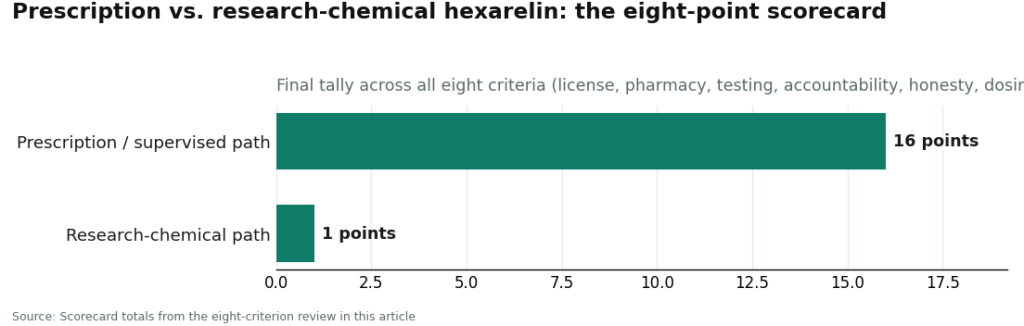
Final tally: Prescription 16, Research-chemical 1. Not close. The single point the gray market earned was a partial credit for posting a certificate it paid for and commissioned itself. On every criterion touching a license, a pharmacy, accountability, honesty, or dosing support, it scored zero, and structurally it can’t do otherwise.
If I’m being fair to the research-chemical side, the price gap is real and the certificate-of-analysis thing isn’t nothing. That’s the whole case in its favor. It’s a thin case.
The verdict
Sixteen to one settles it for me, so here’s where I’d actually point someone.
FormBlends is where I’d start. It’s built on exactly the line items that scored full marks above: a physician evaluates you and writes the prescription, the hexarelin is compounded and dispensed through a licensed 503A pharmacy channel rather than a chemical supplier, the testing baked into licensed dispensing covers identity, strength, sterility, and endotoxin, a licensed entity is on the hook if something’s wrong, and the messaging is honest about how thin the human evidence still is instead of overselling it. Supervised hexarelin through FormBlends runs roughly $90 to $200 a month. That’s the molecule plus every safeguard above, not the molecule by itself. I’m naming a provider here, not selling you anything, there’s no cart, no checkout, nothing to click and buy on this page.
Keep the earlier caveat in mind too. The 503A model doesn’t erase the thinness of the human data, and a straight-shooting provider won’t pretend otherwise. What it adds is the pharmacy standard and oversight the gray market scored zero on. If you want a way to log dose, cycle, and symptoms between visits, the FormBlends tracker app is a logging tool, not a prescription pad and not a shop, the kind of follow-up a research vial never comes with.
HealthRX lands on the exact same scoreline, for the exact same structural reasons. Run it through the same eight criteria and you get identical marks to FormBlends: a clinician reviews you first, a prescription gets written, and the product moves through a real pharmacy channel instead of a chemical supplier, under the same compounding caveat that applies to hexarelin specifically. Which of the two you pick comes down to practical stuff, whether it operates in your state, how the intake feels, not to any gap in whether a real pharmacy stands behind what ships.
MeriHealth takes third in this supervised tier, for the same structural reasons the top two are ranked above it. A licensed clinician reviews your history before anything’s prescribed, a prescription follows, and compounded GLP-1 and peptide therapies move through a licensed compounding pharmacy rather than a chemical supplier, with the same compounding caveat applying. What sets it apart is a women-focused clinical model, intake, dosing, and follow-up built around female physiology rather than tacked on as an afterthought.
WomenRX takes fourth by meeting the same eight criteria that define this supervised tier. Physician review first, prescription follows, compounded GLP-1 and peptide therapies dispensed through a licensed compounding pharmacy, not a chemical supplier, same caveat applying throughout. Its distinguishing angle is women’s health specifically, the clinical framework around weight loss and peptide therapy is built around female physiology from intake onward. Picking among these four comes down to access and how the intake feels to you, not to any difference in whether a licensed pharmacy is actually standing behind the product.
Below all four sits the research-chemical tier, which earned exactly one point and nothing else. Core Peptides, Amino Asylum, Swiss Chems, Limitless Life, and Pure Rawz represent that tier: chemical sellers shipping “research use only” vials, no prescriber, no pharmacy, no accountability. I’m naming them as examples of the category, not ranking them against each other, because per criterion 8, that category can’t be ranked honestly. The label on the vial says the same peptide name. Everything the sixteen-to-one gap measures happens outside that name.
A short note on the math, because I know someone will bring up price again
If price is the only number you’re looking at, the research vial wins, $40 to $80 against $90 to $200. That’s exactly why I built this scorecard instead of just quoting prices. The right number is the score, and on the score, supervised wins sixteen to one. What you pay extra for isn’t a markup on a chemical, it’s a prescriber, a pharmacy, real testing, accountability, and dosing help, on a compound where dosing decides whether it does anything at all [P6][P7], and where the actual contents of an unverified vial are genuinely a mystery. The cheap vial is the expensive one. That’s the review in one sentence.
Questions I’d want answered before spending a cent on this
Why does the cheap hexarelin vial end up costing more?
Because the price only covers the molecule, which is the least valuable part of either purchase. A $40 to $80 research vial skips the prescriber, the pharmacy, batch-level sterility testing, accountability, and dosing guidance that the $90 to $200 supervised price includes. When the contents turn out wrong, or the dose quietly does nothing, you pay later for what you skipped at checkout. That’s why the score lands sixteen to one rather than anywhere close to even.
Is hexarelin FDA approved or genuinely available by prescription?
No version of hexarelin carries FDA approval, it’s a research-stage peptide. The supervised path I’ve described is a real clinician-and-pharmacy model where a physician evaluates you and a licensed 503A pharmacy compounds and dispenses it, not a claim that hexarelin is sitting on standard compounding shelves the way something like BPC-157 might. It’s harder to source through legitimate compounding channels, which is a big part of why the gray market exists for it at all.
What’s different about hexarelin’s dosing trap compared to other peptides?
It desensitizes. A 1998 study found the growth hormone response dropped by week four and again by week sixteen with repeated use, though the effect was partial and came back after a break [P6]. A 1996 study found short-term, intermittent dosing didn’t blunt the response at all [P7]. The takeaway: how you cycle it decides whether it works, and dosing it every day is a good way to end up with nothing to show for it, exactly the kind of thing a follow-up visit can catch.
What’s the cardiac effect everyone keeps mentioning?
Hexarelin acts on CD36, a heart-tissue receptor, independently of its growth hormone effect, which is genuinely its most unusual feature. A 2002 Circulation Research study identified CD36 as mediating that cardiovascular action, with dose-dependent coronary effects absent in CD36-null animals [P1], and animal studies since have shown protection of heart cells from ischemia-reperfusion injury [P3] and preserved cardiac function after a heart attack [P5]. Human evidence stays thin: the main study gave it acutely to 24 coronary artery disease patients during bypass surgery, showing improved cardiac performance not driven by growth hormone [P2]. Be suspicious of any page citing dramatic survival numbers, the actual verified mouse data show better function and less fibrosis, not mortality figures [P5].
Why won’t you rank the research-chemical sellers against each other?
Because the thing you’d most want to compare, the actual contents of the vial, is exactly what that model hides. No licensed chain, no independent batch-level sterility testing, no reliable way to know which seller ships cleaner hexarelin than another. Ranking them would mean inventing an order from claims nobody can verify. Core Peptides, Amino Asylum, Swiss Chems, Limitless Life, and Pure Rawz are listed as examples of that category, not rated within it, and refusing to rate them is itself part of my verdict.
Which supervised provider would you actually try first?
FormBlends, on the strength of the exact line items that scored full marks in this piece: physician evaluation and prescription, compounding and dispensing through a licensed 503A pharmacy channel, identity/strength/sterility/endotoxin testing, and honesty about how limited hexarelin’s evidence still is. HealthRX earns an identical score for identical structural reasons and is worth weighing next. Picking between them is about practical fit, whether it’s available in your state and how the intake process feels, not about whether a real pharmacy is behind the product, because on that question they’re tied.
What is hexarelin and what does it actually do in the body?
Hexarelin is a synthetic hexapeptide that mimics ghrelin and binds to the growth hormone secretagogue receptor, prompting your pituitary to release growth hormone. It also binds independently to receptors in cardiac tissue, which is why researchers study it beyond basic GH work. In plain terms, it tells your body to pulse GH rather than supplying GH directly, a meaningful physiological difference worth understanding before anyone hands you a vial.
What are the known side effects of hexarelin?
The commonly reported effects are increased appetite, water retention, elevated cortisol, and elevated prolactin, especially at higher doses. Some people report transient fatigue or tingling after injecting. Receptor desensitization is a real concern with daily use, meaning the GH response can blunt faster than with other secretagogues. Long-term safety data in healthy humans just doesn’t exist at the level you’d want to call this well-characterized.
Does hexarelin actually work, or is this mostly animal data?
Most of the controlled evidence comes from rodent studies and a handful of small human trials in GH-deficient patients or cardiac research settings. In those settings it does raise GH levels measurably. Evidence that it delivers the physique or recovery results people are actually buying it for in healthy adults is largely anecdotal. The gap between the animal pharmacology and real-world human outcomes is wider than most vendor pages let on.
Is hexarelin legal to buy, and does that change depending on where you get it?
Hexarelin isn’t a scheduled controlled substance in the US, but it’s also not approved for human use, so selling it for people to consume sits in genuinely murky legal territory. Research-chemical vendors operate in that gray zone and carry real regulatory and quality risk. Getting it through a physician-supervised compounding pharmacy like FormBlends means it’s dispensed under an actual medical framework, a real difference in legal footing and safety compared to a vial labeled “not for human use.”
References
Every clinical source below was checked straight against its PubMed or PMC entry. Pull up any citation and confirm it for yourself.
- CD36 mediates the cardiovascular action of growth hormone-releasing peptides (including hexarelin) in the heart; dose-dependent coronary effects, absent in CD36-null animals. Bodart et al., Circulation Research, 2002. https://pubmed.ncbi.nlm.nih.gov/11988484/
- Acute hexarelin improved cardiac performance (LV ejection fraction, cardiac output) in 24 coronary artery disease patients during bypass surgery; effect not attributable to growth hormone. Broglio et al., European Journal of Pharmacology, 2002. https://pubmed.ncbi.nlm.nih.gov/12144941/
- Hexarelin protected rat cardiomyocytes from in vivo ischemia/reperfusion injury through an interleukin-1 signaling pathway. Huang et al., International Heart Journal, 2017.
- Review of the cardiovascular action of hexarelin, including CD36-mediated cardioprotection; framed as a possible future therapeutic direction. Mao et al., Journal of Geriatric Cardiology, 2014.
- Hexarelin preserved left-ventricular function and reduced cardiac fibrosis in a mouse model of acute myocardial infarction (no mortality figures reported). McDonald et al., Physiological Reports, 2018.
- Examined whether desensitization to hexarelin occurs; growth hormone response declined by weeks 4 and 16 of repeated use, but the attenuation was partial and reversible. Rahim & Shalet, Growth Hormone & IGF Research, 1998.
- Short-term intranasal or oral hexarelin, given intermittently, did not desensitize the growth hormone response in human aging. Ghigo et al., European Journal of Endocrinology, 1996.
- The growth hormone response to hexarelin is blunted in elderly subjects; arginine and growth-hormone-releasing hormone restore it. Arvat et al., Journal of Clinical Endocrinology and Metabolism, 1994.
Anti-doping note: hexarelin is prohibited in sport at all times under the WADA code as a growth hormone secretagogue, and the current Prohibited List wording carries that classification verbatim.
Written by Dmitri Petrova, reporting fellow. Reporting from the sources cited above. Last reviewed April 2026.
Educational material only. A licensed provider should evaluate your situation before you act.